 Next.js 14
 Tailwind CSS
 Recharts
 Lucide Icons
 Python
 FastAPI
 SQLAlchemy
 Pydantic
 MySQL 8.0
 Source Code
The Core Problem
Monitoring tells you something broke. Healing fixes it before anyone notices.
We are great at building dashboards that turn red when a database is struggling. But alerting isn't the same as fixing. When a deadlock occurs or a rogue query starts hogging the CPU, an alert goes out. Then, we wait for an on-call engineer to wake up, log in, diagnose the issue, and manually kill the bad query.
By the time that human intervention happens, a minor bottleneck has already cascaded into a full-blown service outage. Under heavy traffic, issues like connection queue starvation and index fragmentation rip through microservices instantly. Human reaction time is simply too slow to stop it.
"Dashboards don't fix databases. When traffic spikes and threads lock up, the gap between an alert firing and a system crashing is measured in milliseconds, not minutes."
Why I Built This
What happens if we teach a database
to defend itself?
I've always found it strange that we treat databases as passive storage buckets. We wrap them in external monitoring agents and assume that's enough. But if the monitoring daemon crashes, or the network drops during a massive workload spike, the database is left completely blind and defenseless.
I built this engine to explore a different approach. By moving the logic for detecting, deciding, and fixing issues natively inside the database engine itself, we remove the fragile network hops between an alert and a fix. The database ceases to be a passive container and becomes an active, self-correcting system.
The Solution
"We don't monitor from outside.
We heal from within."
Operating Model Comparison
How native healing eliminates the network bottleneck
- External agents constantly poll the database for stats.
- Alerts ping the on-call engineer at 3 AM.
- Network hops and human reaction time add minutes of lag.
- Engineers run high-risk remediation scripts manually.
- Stored Procedures natively monitor internal memory and thread states.
- The DB Event Scheduler runs checks without external triggers.
- Zero network latency between detecting a lock and resolving it.
- The database surgically kills rogue queries to save itself.
Intelligence Engine
Teaching the system what "normal" actually looks like.
Hardcoded alerts—like triggering an error whenever CPU usage hits 90%—are practically useless in the real world. A heavy, scheduled backup job might spike the CPU naturally every night, and automatically killing that process would be a disaster. The system needed to understand context.
So, I built an engine that continuously learns what normal behavior looks like for different times of the day. It calculates a rolling historical baseline and only triggers a healing action if the current database behavior mathematically deviates from that specific, time-weighted baseline.
Helps the system measure how far a metric has strayed from the baseline, while safely ignoring massive, momentary spikes.
When traffic is naturally erratic, it loosens the rules to prevent false alarms. When traffic is steady, it tightens them.
System Architecture
A decoupled, native-first orchestration engine.
The architecture is intentionally split. The critical execution loop—detecting anomalies, scoring severity, and executing recovery—runs entirely inside MySQL using Stored Procedures and the Event Scheduler.
A lightweight FastAPI node sits on the outside, simply reading the database's internal logs and passing state vectors to a Next.js dashboard. This ensures the database can still heal itself even if the external dashboard or API goes completely offline.
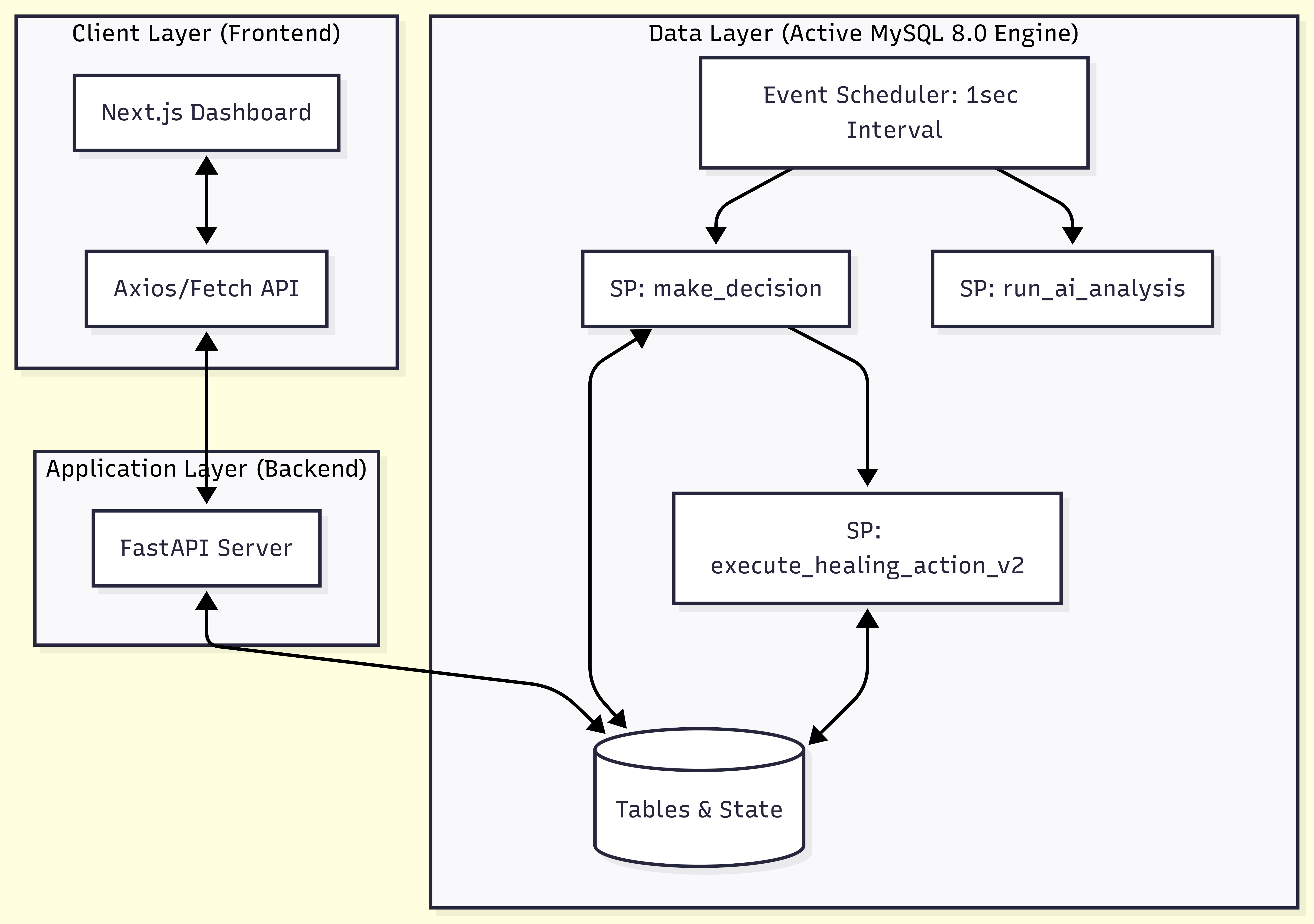
System Architecture & Telemetry Flow
The architecture is split: native database logic guarantees survival, while a Next.js frontend provides human oversight.
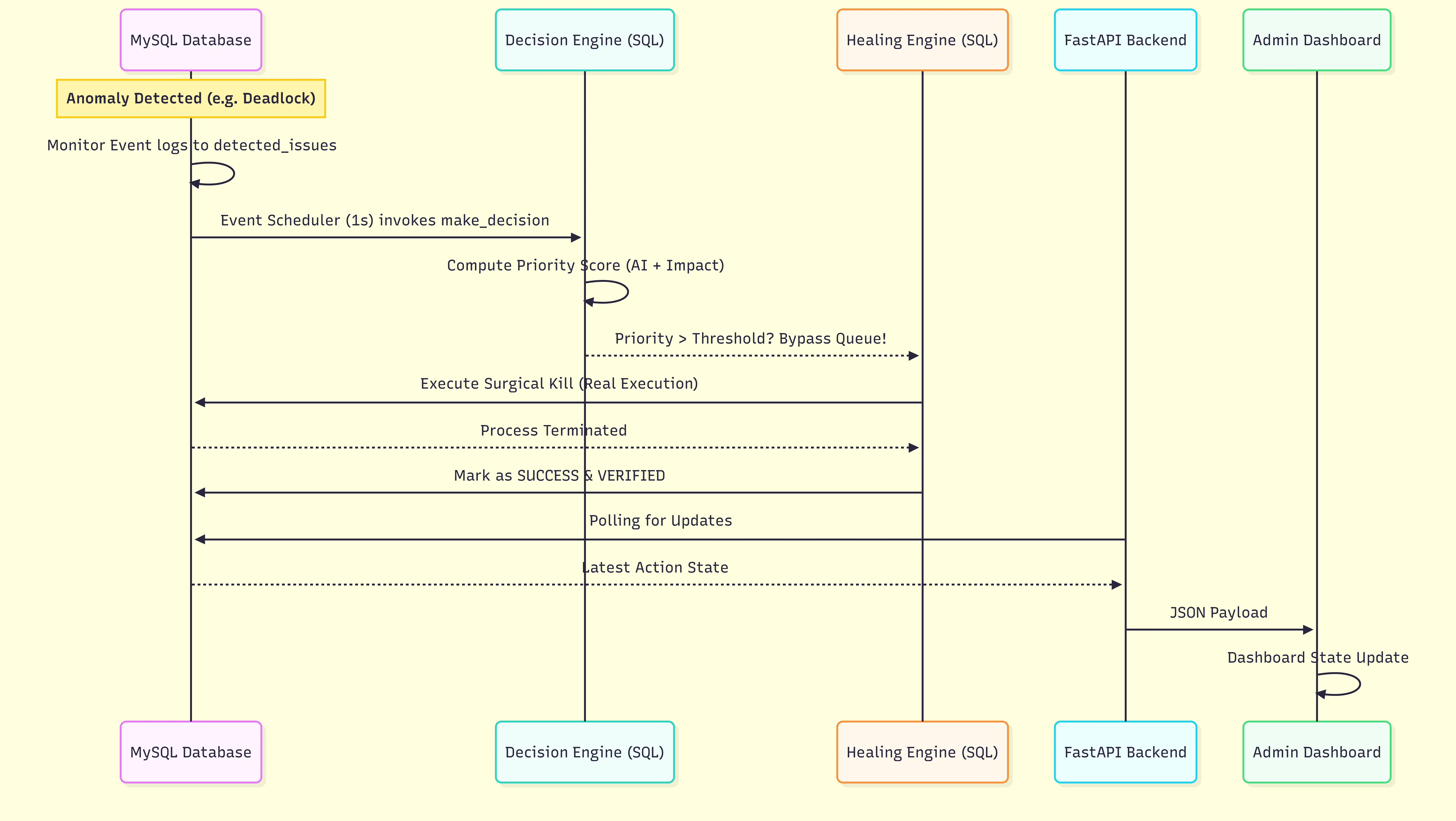
Dynamic Interaction Sequence
How a slow query triggers an internal baseline check, leading to a safe, automated rollback pathway.
Product Walkthrough
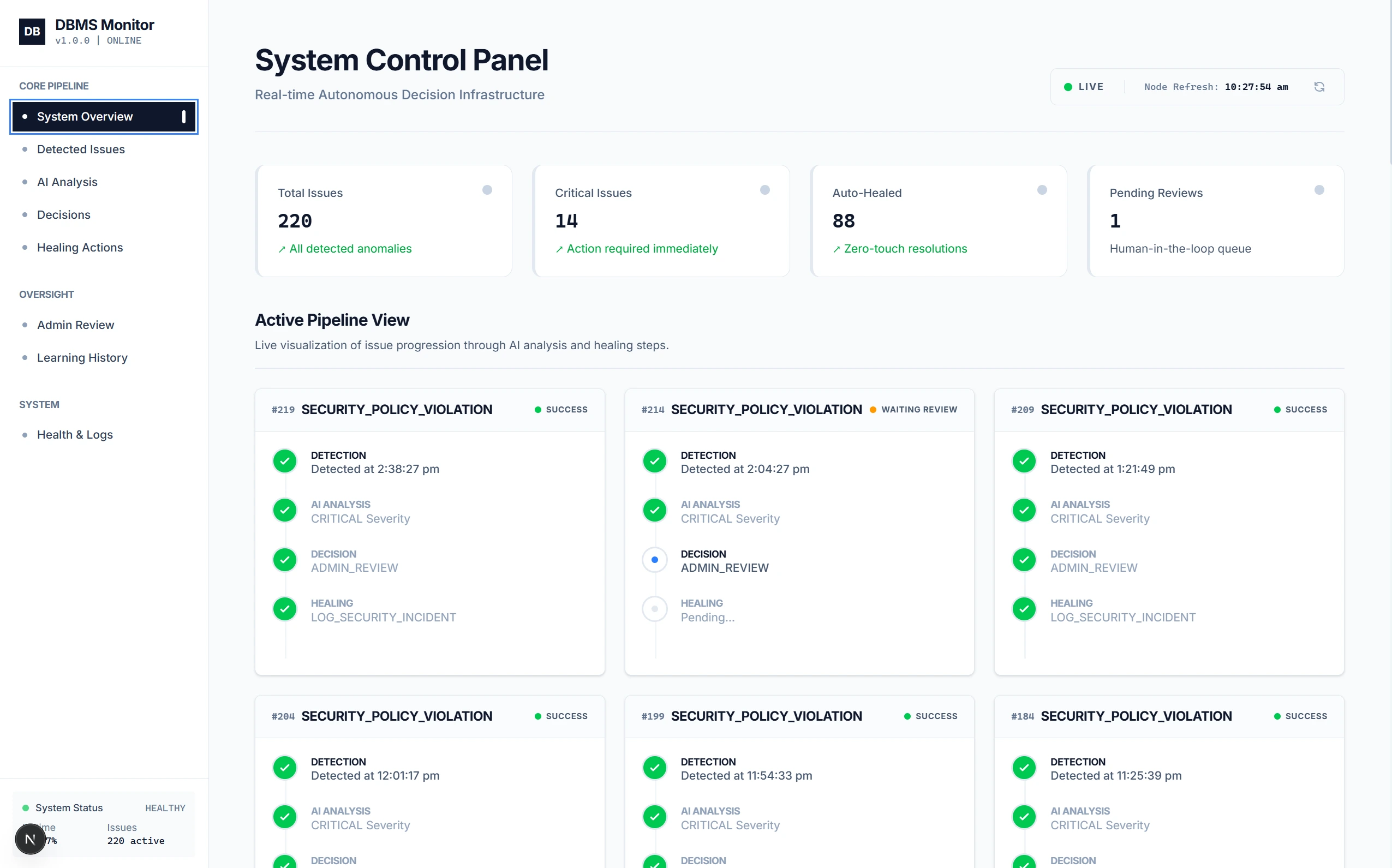
Overview Dashboard - Dark Mode Theme
Real-time visualization of CPU usage, active threads, system errors, database queries per second (QPS), and overall database engine health metrics.